
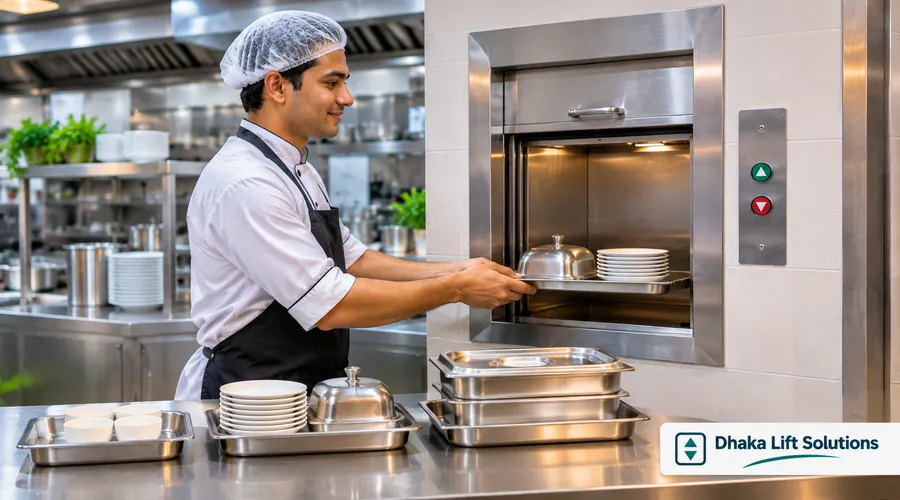
A kitchen sends a few trays upstairs every ten minutes. A hotel moves stacks of plates between floors. A hospital transfers sealed food containers to its wards. All three may use a dumbwaiter, but the load on each trip is different. That is why capacity should be chosen from the goods you carry, not just the number of floors.
Quick answer
Choose 100 kg when the heaviest complete load stays within 100 kg and fits the car. Choose 200 kg when larger batches or heavier containers exceed that limit. Consider 300 kg for loads above 200 kg, but only if the selected model can safely carry the item and the building has space for its car, doors and shaft. All three are goods-only lifts.
100 kg, 200 kg and 300 kg: the practical difference
A rated load is the maximum permitted weight inside the car. Count the goods and everything travelling with them: the metal trays, plates, boxes, racks or trolley. The rated figure does not tell you how wide the door is, how tall the opening is, or how quickly the lift can complete repeated trips.
| Rated capacity | May suit | Check before choosing |
|---|---|---|
| 100 kg | Small food batches, dishes or documents at counter height | Maximum tray stack, door opening and peak-service load |
| 200 kg | Larger batches of food containers, plates or hotel supplies | Total weight of loaded rack, car dimensions and number of trips |
| 300 kg | Heavier goods batches and, on suitable designs, loaded trolleys | Floor-loading option, wheel loads, threshold, door and shaft space |
Important: These are examples of use, not promises that every manufacturer offers the same car or door design. Some models load at counter height; others are designed for floor-level loading. A 300 kg rating alone does not mean a trolley will fit.

How to choose the right dumbwaiter capacity
1. Weigh one complete trip, not one item
Suppose a restaurant plans to send twelve filled trays, each weighing 5 kg. That is 60 kg. If the rack holding those trays weighs another 14 kg, the planned travelling load is 74 kg. A 100 kg model could be a candidate on weight alone. The next question is whether the rack passes through the door and fits inside the cabin.
Now picture a hotel moving eighteen food pans at 7 kg each, plus a 15 kg rack. The total is 141 kg. A 100 kg unit is too small for that trip. A 200 kg model could be considered, subject to its car, door and loading arrangement.
These figures are worked examples, not measurements from a real Dhaka Lift Solutions project. Use your own busiest-day loads when selecting equipment.
2. Measure the biggest object
A tall rack may weigh only 65 kg but still be too high for a small dumbwaiter. Measure its height, width and depth, including handles and anything that sticks out. Compare those dimensions with the clear door opening and the usable car space. They are not the same measurement.
For detailed cabin, door and shaft measurements, use the separate dumbwaiter size and shaft guide. This article stays focused on rated carrying capacity.
3. Think about rush-hour trips
A café may manage well with small loads throughout the day. A banquet kitchen may need to send several large batches within fifteen minutes. More capacity can reduce the number of trips, but it does not automatically improve speed. Floors served, travel distance, door operation, and loading time all affect the result.
Ask the kitchen team what happens during its busiest service, not just during a quiet morning. That often reveals a better load estimate.
4. Decide between counter loading and floor loading
A counter-height opening makes sense for trays, dishes and sealed food pans. A floor-level opening may be more suitable for a wheeled rack or trolley, where the equipment is specifically designed for that job. Door type, landing level, wheels and threshold all matter. Do not roll a trolley into a counter-loading design.
Which capacity makes sense for your building?
Restaurants and cafés
A 100 kg dumbwaiter lift in Bangladesh may suit a restaurant that sends modest loads between a ground-floor kitchen and an upstairs dining room. If a busy lunch service means moving several heavy pan stacks at once, a 200 kg option deserves a closer look. Check that any trays are stable and that hot containers can be handled safely.
Hotels and banquet kitchens
Hotels may move plates, linen or packaged supplies between service floors. A 200 kg dumbwaiter lift in Bangladesh can be a starting point for reviewing larger batches, but the right capacity comes from the loaded trolley or rack weight. If regular trips exceed 200 kg, compare a 300 kg goods-only design with the actual service route and opening sizes.
Hospitals and clinics
Hospital use needs more than a capacity choice. It matters whether the lift carries food, sealed supplies or other permitted goods. Clean and used items may need separate handling procedures. A 300 kg dumbwaiter lift in Bangladesh might be considered for heavier planned loads, but infection-control practice, cleaning access and the manufacturer's permitted uses must also be reviewed. Never use a dumbwaiter to carry a patient or member of staff.
A useful rule: If the load is light but bulky, look at cabin and door size first. If the load is compact but heavy, start with the actual total weight. If it is both bulky and heavy, review the full model and building layout before choosing a capacity.
Why the loading arrangement matters as much as kilograms
A good selection must work at every landing. Check where staff will stand, how a tray or trolley crosses the threshold, and whether doors can close without touching the load. The lift should have the safety devices required by its design and the rules that apply to the project.

During a technical review, ask about landing-door interlocks, overload protection, car stopping position, safe access for maintenance and what happens during a power failure. The exact equipment and service procedure depend on the supplied model. Staff should not bypass door protection or operate a faulty lift.
Some manufacturers offer both table-height and floor-loading dumbwaiters. That design difference can matter more to the daily workflow than an increase from 100 kg to 200 kg. For an introduction to what a dumbwaiter can and cannot carry, read what a dumbwaiter lift is.
What to send for a meaningful capacity recommendation
Before asking for a specification, collect this short set of facts. You do not need a finished architectural drawing to begin the discussion, but accurate measurements will help later.
- Heaviest complete load, including containers and racks
- Largest item: width, depth and height
- Number of floors and required stops
- Approximate vertical travel distance
- Counter-height or floor-level loading
- Available shaft and landing space
- How many trips are needed at peak time
- Building location and available power information
If you are still deciding which type of goods lift is suitable, see the dumbwaiter lift product overview. For a kitchen-led project, the food lift options page covers that application. A larger industrial load may instead need a cargo lift, rather than a small service lift.
Three selection mistakes worth avoiding
- Picking from a menu or floor count. A three-floor building does not necessarily need more capacity than a two-floor building. The actual weight and service pattern decide.
- Leaving out the container weight. Stainless pans, racks, bottles, trays and a trolley can add significant weight to a load.
- Assuming 300 kg means more space. Larger rated capacity and larger internal dimensions are related in some product ranges, but the chosen manufacturer's drawing is what settles fit.
When comparing offers, ask suppliers to state rated load, usable internal size, clear opening, loading arrangement, safety devices and exclusions in writing. The related guide on reading a lift quotation explains how to compare what is included.
Frequently asked questions
Is a 100 kg dumbwaiter enough for a restaurant?
It may be enough for trays, dishes or small batches if the total loaded weight stays within 100 kg and every item fits through the clear door opening. A kitchen that sends heavy pan stacks in one trip may need a larger option.
Does a 200 kg dumbwaiter need twice the shaft space of a 100 kg lift?
No. Shaft dimensions do not scale directly with rated capacity. The car, drive, door and manufacturer design determine the space needed. Compare actual model drawings.
Can a 300 kg dumbwaiter carry a trolley?
Only if the specified lift is designed for that loading method, the trolley fits, and its combined weight and wheel loads are within the approved limits. A 300 kg counter-loading dumbwaiter should not be treated as a floor-loading trolley lift.
Can people ride in a 100, 200 or 300 kg dumbwaiter?
No. These dumbwaiters are intended to carry goods, not passengers. Use an appropriate passenger or goods-and-passenger lift where people need to travel.
Will a bigger dumbwaiter always make service faster?
Not always. It can carry a heavier batch, but travel time, door cycle and loading time still count. Choose using both the busiest load and how often staff need to send it.
Have a load list and a kitchen plan?
Share your heaviest full load, the number of stops, and the space available at each landing. That gives the technical team a useful starting point for discussing 100 kg, 200 kg or 300 kg dumbwaiter options.
Request a Lift Quotation