
Dumbwaiter Lift in Bangladesh for Food and Small Goods
Food trays, files, medicine boxes or small supplies should not need a trip up the stairs each time. A dumbwaiter moves these items between floors through a compact goods-only lift. The right layout starts with the load, counter height, number of stops and space in your building.
A small lift for goods, not a lift for people
A dumbwaiter is a compact lift that carries small goods between floors. It often serves kitchens, hotels, clinics, offices or stockrooms where staff make many short deliveries.
The important measurements are the largest item, its full loaded weight and the height at which people will put it into the car. A tray that slides in at counter level needs a different opening from a trolley that loads at floor level.
Do not use a dumbwaiter to carry a person. If staff must travel with goods, ask for a lift designed and approved for that use.

Put the opening where the work happens
In a tight room, the wrong loading height is a daily nuisance. Staff may have to lift a hot container too high, bend to reach a low car, or carry a tray around a counter to reach the door.
Plan the opening with the worktop, nearby doors and walking space. Check both ends of the trip—an easy loading floor is no help if the unloading floor is cramped.
- Check the largest tray or box, including its handles.
- Leave room to open the landing door and set items down.
- Confirm whether one-side or opposite-side openings are needed.
- Keep controls within reach without putting them in a wet cleaning area.
What decides the dumbwaiter specification?
There is no one car size or shaft drawing for every building. Start with the items your team actually carries and the room they move through.
Choose the loading route before the door layout
These are common planning approaches, not promises that every model offers each option. Final arrangements depend on the supplier's equipment drawings and the building.
| Loading arrangement | When it may suit the job | What to check |
|---|---|---|
| Counter-height opening | Trays, covered meals, dishes and hand-carried boxes. | Worktop level, car shelf, landing door and space to set items down. |
| Floor-level loading | Loads that are best set down low or handled on a small wheeled base, where the model allows it. | Door sill, access, load size and the chosen car-floor rating. |
| Through-loading | Goods enter from one side and leave the opposite side. | Shaft space, door placement and the route on both floors. |
| Same-side loading | A single wall face is available at each serving point. | Landing clearance and where staff stand to load and receive items. |
Make room for the lift before closing the wall
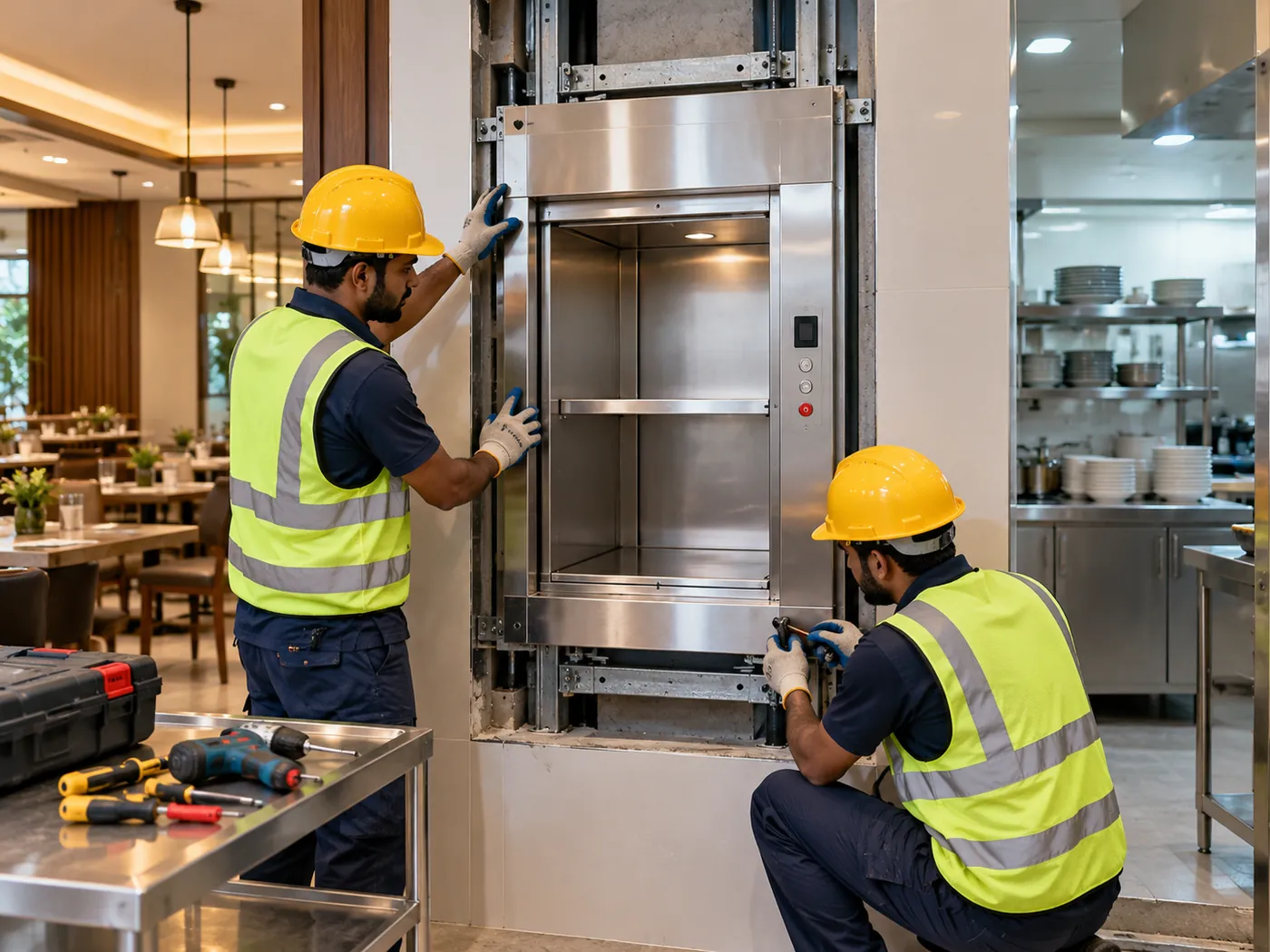
A small dumbwaiter still needs a suitable shaft or frame, a working landing opening, power and access for testing. On a finished site, those details may be harder to change than the lift itself.
- Agree the car and door position before counters or wall finishes are fixed.
- Check the structure and any pit or top clearance required by the model.
- Coordinate the power point, isolator and control cable route.
- Leave a practical route for installation and future service work.
For an existing building, photos of both landing areas help show what may need to be changed.

Frequent short trips still mean wear
In a busy service area, doors may open and close many times a day. The lift should be used within its rated load, and staff should know what to do when a landing door will not close.
- Keep car and landing openings free of loose items.
- Do not force a stuck door or bypass its interlock.
- Keep the controls and car clean using the maker's approved method.
- Arrange routine checks for doors, guides, switches and controls.
Check the symptom; do not guess the faulty part
A lift that does not respond may have a landing-door, control or power problem. It does not mean a motor needs replacing. A qualified service team should find the cause before parts are changed.
Make a note of which landing is affected, whether the car is loaded, and what the controls show. Keep the lift out of use if a fault could affect safe operation.

What affects dumbwaiter lift price in Bangladesh?
A small two-stop unit and a custom multi-stop unit can have very different costs. There is no useful fixed price until the load, size, doors, shaft and installation work are defined.
Dumbwaiter lift FAQs
Can a dumbwaiter carry people?
No. A dumbwaiter is a goods-only lift. Never use it to move a person. If a worker needs to travel between floors, the project needs a lift designed for passengers.
What can I send in a dumbwaiter?
Food trays, dishes, files, parcels and suitable small supplies are common examples. The load, item size and permitted use must match the selected unit. Medical waste or other special materials need separate handling review.
What size dumbwaiter lift do I need?
Measure the largest loaded item, including handles, and the space needed to slide it through the door. Then review the loading height and available shaft. Final car and shaft sizes come from the chosen model.
Is counter-height loading better than floor-level loading?
For hand-carried trays and dishes, a counter-height opening often fits the work. Floor-level loading may suit other goods if the selected unit supports it. Choose from the daily task and room layout.
Can I add a dumbwaiter to an existing building?
Sometimes. The space through the floors, structure, landing openings, power and installation access need checking. Do not cut walls or floors before the equipment layout has been reviewed.
Does every dumbwaiter need a pit or machine room?
No single rule fits every design. Some compact models have little or no pit and no separate machine room; others need different clearances. Ask for the chosen maker's shaft and equipment drawings.
How much does a dumbwaiter cost in Bangladesh?
The price depends on capacity, car size, stops, doors, the shaft or frame, finish, electrical work and installation. A quote based on site details is more useful than an unverified fixed price.
What should I send for a quotation?
Share the site location, floors served, largest item size, loaded weight, preferred loading height and any room or shaft photos. A sketch is useful if you do not have formal drawings yet.
Show us what needs to move between floors
A tray size, load estimate, number of stops and photos of the proposed openings are enough to start. We can use those details to review suitable dumbwaiter options and the site work to check next.
- Type of food or goods
- Largest item and loaded weight
- Number of stops and loading height
- Room, shaft or landing photos
- Building location and power information