Elevator Modernization
For projects involving several major lift systems rather than primarily the controller and drive.
View elevator modernization →
An aging lift does not always need complete replacement. Where the mechanical system remains suitable, upgrading the controller and drive system may provide a practical route to modernizing how the elevator starts, runs, stops and responds to calls.
The important part is compatibility. The controller, VVVF drive, motor, encoder, doors, safety circuits and existing wiring need to work as one system.
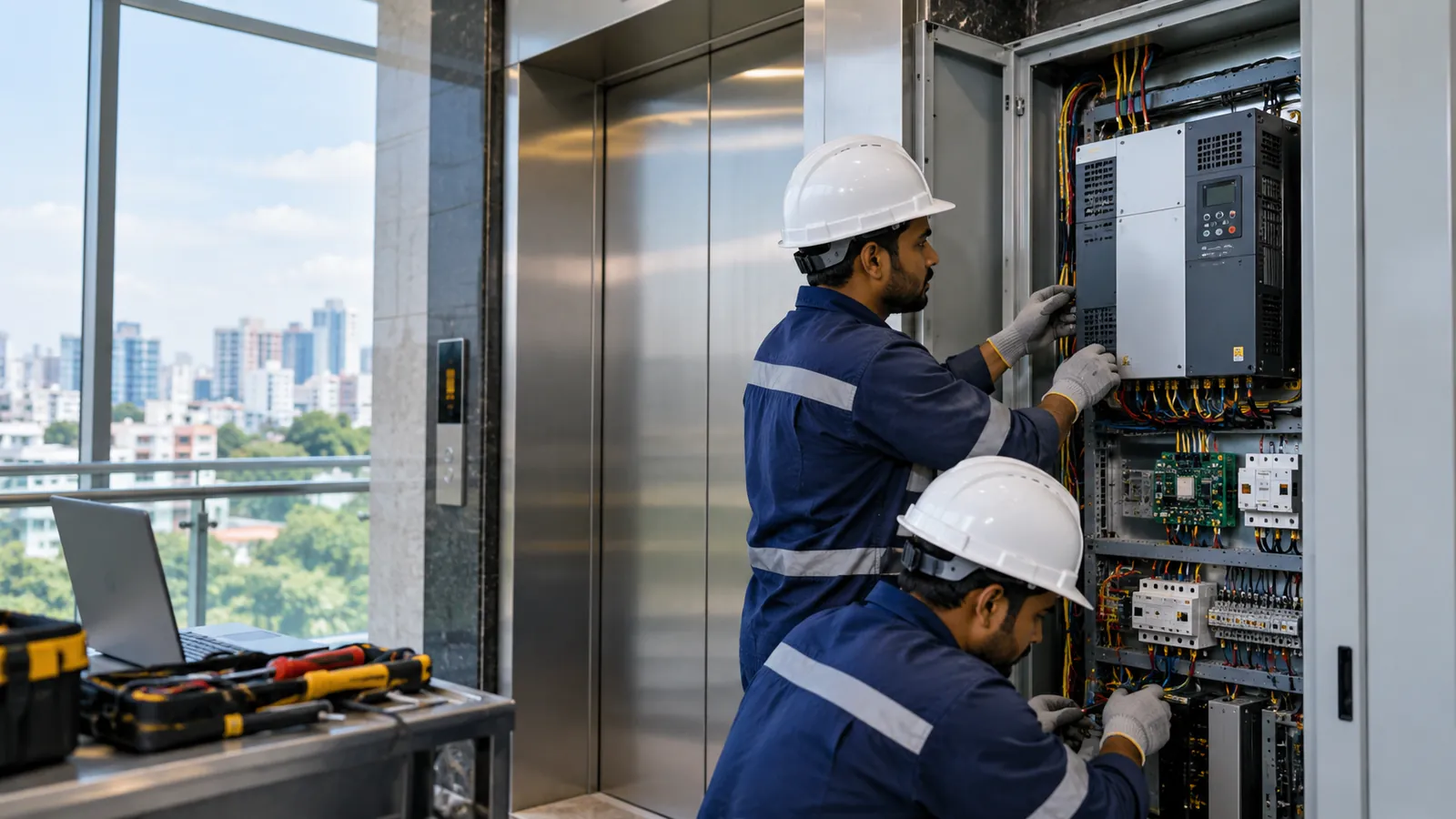
An elevator controller upgrade replaces or modernizes aging control equipment while retaining suitable existing lift components. A VVVF upgrade may be part of that work, but the new controller and drive must be selected around the existing motor, feedback system, doors, safety circuits and operating requirements.
A failed board can sometimes be repaired or replaced. A different question arises when an older control system becomes repeatedly difficult to maintain.
Before choosing modernization, the existing lift should be assessed. The purpose is to determine whether the problem is limited to one repairable fault or whether the controller and drive platform itself has become a maintenance constraint.

Controller modernization needs a system-level view. A technically suitable solution considers the equipment sending information to the controller, the controller and drive themselves, and the equipment receiving commands.
Landing calls, car commands, position or speed feedback, door status, load-related inputs and safety-circuit conditions.
The control system interprets operating conditions and coordinates movement, acceleration, deceleration, stopping and other lift functions.
Traction motor, brake, door equipment, operating panels, indicators and other connected devices relevant to the particular installation.

Identify the existing controller, drive, motor, encoder or feedback arrangement, door equipment, operating panels, wiring and relevant interfaces.
Determine which equipment can remain and which components need replacement or adaptation for the proposed control platform.
Replace the aging control cabinet, boards or associated control equipment included in the agreed modernization scope.
Match and configure the drive for the relevant motor and control arrangement. Drive selection should not be based on appearance or price alone.
Integrate the required door, position, landing, car, safety and other signals needed by the selected system.
Set relevant parameters, verify connected functions and carry out the testing required before the upgraded lift returns to normal operation.
Current controller-modernization guidance consistently treats the controller, VVVF drive, motor, encoder, doors and safety interfaces as connected parts of one system.
That is especially important when modernizing an older lift whose existing equipment may use different feedback methods, wiring arrangements or control interfaces.
Record the existing controller, drive, motor, feedback arrangement, doors, signals and relevant site conditions.
Separate suitable reusable equipment from obsolete, incompatible or condition-dependent components.
Establish how the proposed controller will connect with the drive, motor feedback, doors, operating signals and safety-related circuits.
Complete the agreed electrical/control work and configure the relevant operating parameters for the installed system.
Verify operating functions and resolve commissioning observations before returning the elevator to normal service.


Modernization changes the way multiple lift functions communicate. Testing therefore needs to look beyond whether the new cabinet powers on.
The exact commissioning programme depends on the equipment and project scope, but affected functions should be checked systematically before normal operation.
One reason to assess an existing elevator carefully is to determine whether suitable mechanical equipment can remain in service while the control system is modernized.
An upgrade enquiry is easier to assess when the existing system can be identified clearly. Available information may include:
A site assessment is usually more useful than choosing a controller from a generic specification alone.
It involves modernizing the variable-voltage variable-frequency drive arrangement used to control motor operation. In an older elevator, this may be carried out together with controller modernization so the controller, drive, motor and feedback system work correctly together.
Not necessarily. The controller and VVVF drive perform related but different functions. A modernization project may replace both, or may retain suitable equipment depending on compatibility, condition and project requirements.
In some modernization projects, suitable existing mechanical equipment can remain. That decision requires technical assessment of the motor, drive arrangement, feedback system and the proposed controller rather than an automatic assumption.
Its condition and compatibility need to be checked against the proposed controller, motor, feedback arrangement and operating requirements. The answer is system-specific.
No. Recurring faults can come from doors, wiring, sensors, mechanical equipment, power conditions or other parts of the lift. Troubleshooting and assessment should establish whether the controller is actually part of the underlying problem.
Yes. The functions affected by the modernization need to be configured and checked before normal operation. The exact testing and commissioning scope depends on the installed equipment and applicable project requirements.
Send the building location, number of stops, available controller and drive details, motor information if available, clear equipment photos, and a short description of the existing problems or modernization objective.
Share the existing controller, drive and lift information first. A technical assessment can then define the likely compatibility questions, upgrade scope and information needed for quotation.