
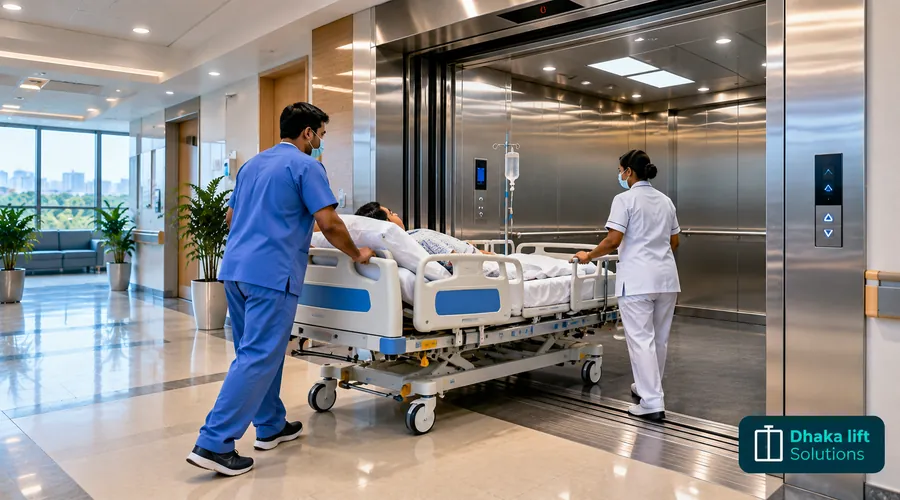
A hospital lift may carry only three people on a busy trip, yet still need a much higher load rating than an ordinary passenger lift. The reason is simple: a patient may arrive on a heavy bed with a nurse, a porter, an oxygen cylinder and a monitor. All of that has to travel together, safely and without a struggle at the doorway.
This hospital lift capacity guide looks at the 1,000–1,600 kg range often discussed for clinics and healthcare buildings in Bangladesh. It explains what those ratings can mean, when more space is needed and what to check before the building team approves a lift.
Quick answer
Choose hospital lift capacity from the heaviest planned patient-transport trip, not the passenger count printed in a brochure. A properly sized 1,000 kg long-car lift may suit some stretchers. Intermediate 1,275–1,350 kg configurations can offer additional room or load, depending on the model. A 1,600 kg healthcare lift is a common starting point to discuss for hospital beds with attendants. Larger ICU beds or substantial equipment may require more than 1,600 kg. Check the actual bed, clear door opening, cabin dimensions and approved engineering drawings before deciding.
What does a hospital lift's kg rating mean?
The rated load is the maximum load the lift is designed to carry under its approved specifications. It includes the patient, bed or stretcher, staff and any equipment travelling inside. The number does not tell you how long the cabin is or how wide its door opens.
For instance, a 1,000 kg lift may be advertised as a 13-person passenger lift. That does not make it suitable for every hospital bed. A long stretcher needs enough internal depth and an entrance that staff can use without striking the frame. In patient transport, the physical arrangement can matter as much as the load rating.
This is why the hospital lift size and door-planning guide covers cabin, entrance and turning space separately. This article stays focused on choosing the load rating.
1,000 kg vs 1,350 kg vs 1,600 kg hospital lifts
These are planning categories, not promises that a particular bed will fit. Different manufacturers may offer different car shapes and door arrangements at the same load rating.
| Rated capacity | Where to assess it | What must be confirmed |
|---|---|---|
| 1,000 kg | Stretcher movement, wheelchair access and smaller patient-transfer tasks where an approved long-car model is available | Actual stretcher length, staff positions, door clearance and total moving load; do not assume a full hospital bed will fit |
| 1,275–1,350 kg | Intermediate healthcare configurations where extra capacity or a different cabin layout is useful | Model availability, usable floor area, bed type, attendants and door layout; these ratings are not interchangeable |
| 1,600 kg | Patient-bed movement with accompanying staff in a purpose-designed healthcare car | Full bed footprint, attachments, clear opening, room for attendants and specific manufacturer drawings |
| Above 1,600 kg | Larger intensive-care beds or trips with more ancillary equipment | A full equipment and space assessment; do not try to solve every ICU transport need by choosing 1,600 kg |
Reference note: ISO 8100-30:2019 covers installation dimensions for lift classes that include healthcare use. A published EN 81-70 accessibility explainer also describes a 1,000 kg long-car arrangement for stretcher use. These references help compare designs; neither is a site-specific Bangladesh approval or a guarantee that any listed load fits your equipment.
Why 1,000 kg can work for a stretcher but not every bed
A narrow wheeled stretcher and an adjustable hospital bed are not the same item. A hospital bed can have a longer wheelbase, side rails, head and foot sections, a powered frame and attached devices. If staff must hold an IV stand or monitor beside the bed, the needed space changes again.
A 1,000 kg lift is worth considering for a clinic that mainly moves walking patients, wheelchairs and a specified stretcher. But the building team must check the cabin's clear internal length, not just its rated load. If the facility expects full bed transfers from wards to an operating theatre or intensive-care unit, review larger hospital-specific cars before fixing the shaft.
Useful distinction: The bed's weight and the space it takes up are two separate checks. Passing a load calculation does not mean that staff can move it through the door and stand clear of the closing panels.
When is a 1,600 kg bed lift the better option?
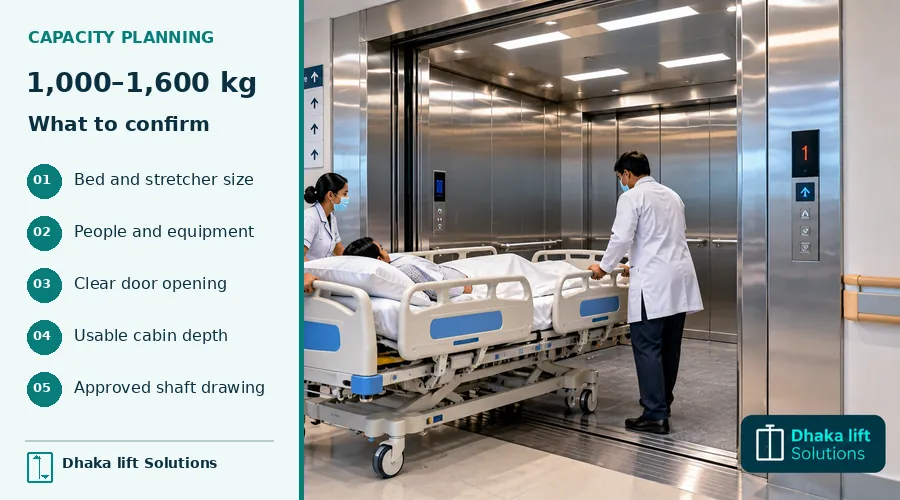
A 1,600 kg option becomes more relevant where a hospital moves patients while they remain in their beds. It can offer a purpose-designed car layout for attendants to travel alongside, provided the specific model has the depth and door opening required. The word can matters: not every 1,600 kg cabin is identical.
For a new hospital in Dhaka or another Bangladesh city, the care team should list the equipment expected on routine and emergency trips. Include full patient beds, portable monitors, oxygen equipment and the staff needed to move the patient. Ask suppliers to propose a dimensioned cabin, not just the kg figure.
If heavy bariatric beds, complex ICU transfers or multiple equipment trolleys are planned, do not assume 1,600 kg is enough. Some healthcare lift designs use higher ratings for these jobs. Final selection belongs to a project engineer working with the hospital's clinical team.
How to calculate the load for your busiest patient transfer
Start with the complete trip, not an average lift journey. A useful worksheet accounts for every item likely to be inside at the same time.
- Patient: use a suitable upper planning weight identified by the healthcare team.
- Bed or trolley: take the manufacturer's actual equipment weight, including attachments that stay fitted.
- Attendants: count the people who must travel with the patient, rather than people who merely meet the bed at the landing.
- Medical equipment: add monitors, oxygen cylinders, pumps and other equipment carried on the trip.
- Operating margin: have the engineer assess the planned operating case and select a compliant lift model rather than choosing a car that only just matches an estimate.
The sum is one input to the selection. It does not replace cabin layout, accessibility and clinical workflow checks. A patient transfer is not safe merely because the total kilograms fall below the nameplate rating.
Check these six details before deciding capacity
1. Actual bed and stretcher sizes
Measure the longest and widest equipment in the hospital's current or planned inventory. Include raised side rails, bed handles and attached devices in their usual moving positions. If procurement is still open, agree on a future equipment envelope rather than guessing from a photograph.
2. Staff standing positions
Someone may need to guide the head of the bed while another person manages a monitor or trolley. Their space cannot be replaced by a higher load rating. The cabin should allow staff to operate without blocking the entrance or controls.
3. Clear door opening
Use the finished clear opening with the door fully open, not the rough structural width. Confirm whether the lift uses centre-opening or side-opening doors and how the bed approaches the landing. A narrow turn in front of the lift can spoil an otherwise good choice.
4. Number of floors and patient traffic
A small clinic may need an occasional bed transfer. A hospital serving wards, imaging, surgery and emergency care may see several trips close together. The number of lifts, their position and how they are used should be reviewed alongside each car's capacity.
5. Power, levelling and controls
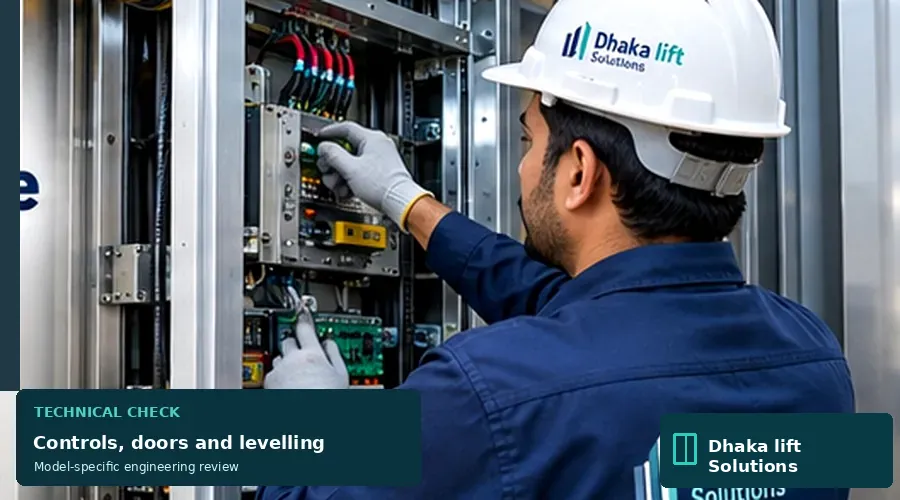
Discuss smooth starts and stops, accurate landing levelling, appropriate door protection and what happens during a power failure. Confirm the building's emergency-power strategy with the electrical team; an automatic rescue device alone is not a complete hospital backup plan.
6. Finished shaft and structural limits
The larger the selected lift, the more carefully the team must coordinate the lift well, pit, overhead, guide rails and associated loads. Do not build a shaft from a generic online capacity table. Use the selected supplier's approved site drawings.
What changes between a clinic and a full hospital?
In a diagnostic centre, people may walk in, use a wheelchair or arrive on a compact stretcher. In a multi-storey hospital, beds may move between wards, surgery, imaging and intensive care. The latter brings longer equipment, more urgent journeys and more staff who need to travel together.
That does not mean every clinic needs the smallest lift or every hospital needs the largest. A clinic planning day surgery might need a bed-ready car. A larger facility may also need a separate passenger lift to keep visitor traffic away from patient-transfer routes. Plan for the service offered, not the building label.
How should Bangladesh projects check standards?
ISO 8100-30 is a useful international reference for lift installation dimensions. For local approval, the architect and lift consultant should check the applicable Bangladesh National Building Code material published by HBRI, the project brief and the selected manufacturer's documents. No standard number mentioned here by itself confirms compliance for a particular project.
Also coordinate infection-control finishes, emergency arrangements, lift availability during maintenance and the route from patient rooms to clinical departments. These decisions affect how usable the lift will be after handover.
Hospital lift capacity checklist for your quotation
A supplier can give a more meaningful technical response when the first enquiry contains real measurements and use details. Send:
- Building type and clinical departments served.
- Number of floors, stops and estimated patient transfers.
- Largest patient bed or stretcher's full dimensions.
- Bed, patient, attendants and equipment planning weights.
- Number of people who must accompany a patient.
- Measured landing and corridor turning space.
- Available shaft, pit and overhead dimensions.
- Clear door-opening requirement and entry direction.
- Emergency power and preferred operating arrangements.
- Architectural drawings and any renovation constraints.
When you compare proposals, ask each supplier to show the rated load, internal cabin dimensions, clear opening and what is included in the quoted package. The price alone will not show whether two lifts can perform the same patient-transfer task.
Common mistakes when choosing a hospital bed lift
- Buying from the passenger count. A person count is not a bed-transport specification.
- Checking weight but not length. The equipment can be below the rated load and still be too long to enter.
- Leaving out attendants and devices. A real patient trip may carry more than a patient and bed.
- Copying another building's cabin drawing. Similar capacities can have different door and shaft layouts.
- Waiting until the shaft is built. Capacity, usable cabin size and building openings should be coordinated early.
Frequently asked questions
Is a 1,000 kg lift enough for a hospital stretcher?
It can be, if the selected car has suitable length, width and door clearance and the full planned load is within its rating. Check the actual stretcher and attendant arrangement. Do not assume it can take every full hospital bed.
Is 1,600 kg always enough for an ICU bed?
No. Some ICU beds and their attached equipment need more room or load capacity. Use the hospital's largest planned transfer and obtain model-specific dimensions and an engineering assessment.
Does a higher kg rating guarantee a bigger cabin?
Not in one fixed shape. Cabin size generally depends on the rated load and the selected model, but car depth, width and entrance layout can differ between suppliers. Compare the actual usable measurements.
Can a 1,350 kg lift replace a 1,600 kg hospital lift?
Only if the exact proposed 1,350 kg configuration meets the building's equipment, staff, access and operational requirements. A smaller rated load should not be treated as an automatic substitute.
What should I send for a hospital lift quotation in Bangladesh?
Send your building plan, floors served, lift shaft details, largest patient-bed dimensions, attendants and equipment needs, and any power or renovation constraints. Ask for the proposed cabin and clear entrance measurements in writing.
Discuss a hospital lift that fits the actual work
Share the building plan and the largest bed or stretcher you expect to move. Request a technical discussion of load capacity, usable cabin space and door access before choosing a model.
Request a Hospital Lift Quotation