
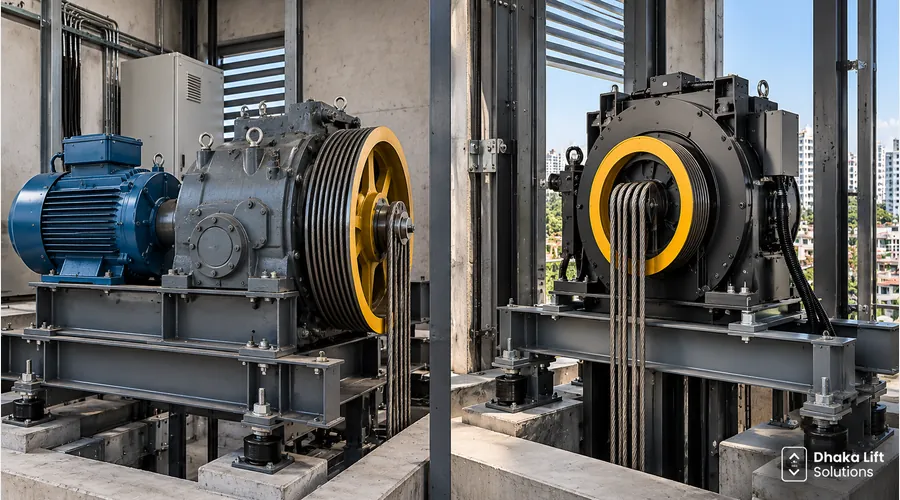
Two lifts can look exactly alike from the lobby, yet use different machines to move the cabin. One has a gearbox between the motor and sheave. The other drives the sheave directly. That small-sounding difference affects efficiency, equipment layout and the kind of maintenance the lift needs.
For a new apartment block or an older lift under repair, it is worth understanding the drive before comparing quotations. The label alone does not tell you whether a lift will be quiet, reliable or suitable for the building.
Quick answer
A geared traction elevator has a reduction gearbox between its motor and drive sheave. A gearless traction elevator drives the sheave without that gearbox. Gearless designs can avoid the gearbox's mechanical losses and lubrication work. Geared drives may still be a practical option for some existing installations. The better choice depends on load, speed, travel, traffic, site conditions and service support—not the name of the drive.
Where is the difference inside the machine?
Geared traction: motor, gearbox, then sheave
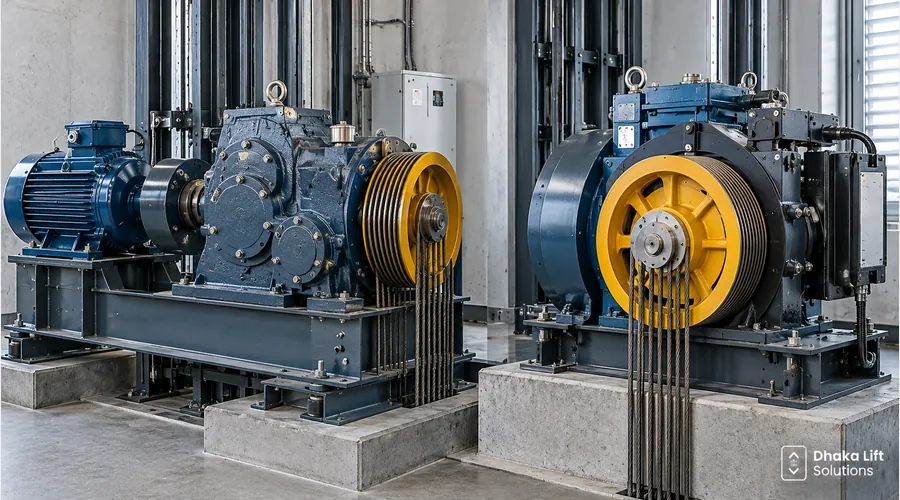
In a geared traction machine, the electric motor turns through reduction gears before the traction sheave rotates. The gearbox helps match the motor's speed and torque to the lift's mechanical needs. The sheave grips the suspension ropes, which move the car and counterweight.
Many older lift installations use geared traction machines. A geared system is not automatically poor or unsafe. Its performance depends on the complete installation, including the controller, brake, guide rails and upkeep.
Gearless traction: the motor turns the sheave directly
A gearless machine removes the reduction gearbox. Its motor drives the traction sheave directly. Modern designs often use a permanent-magnet synchronous motor with an electronic drive, though the exact motor and control system vary.
There is no conventional reduction gearbox to lubricate, and eliminating that transmission stage can reduce mechanical energy losses. It does not remove the need to inspect the machine brake, bearings, encoder or other feedback equipment, suspension ropes or belts, and safety devices.
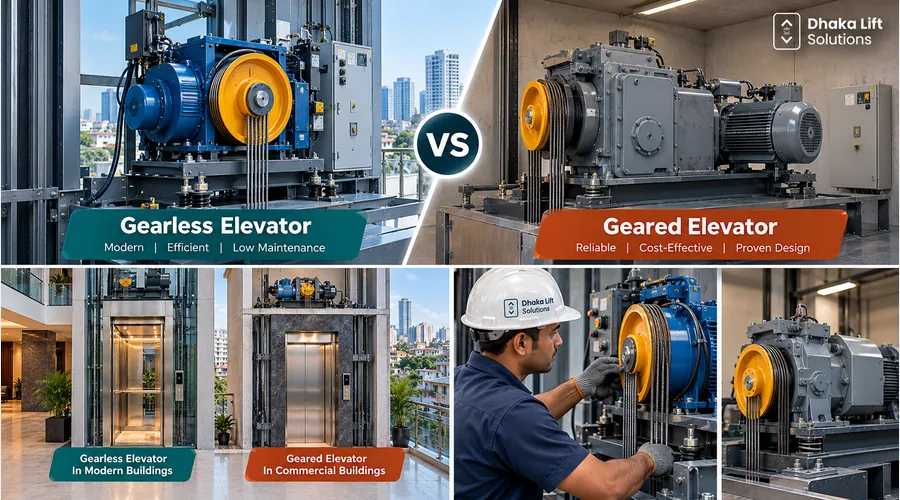
Gearless vs geared elevator: side-by-side comparison
Use these differences to frame questions for the supplier. They are general engineering patterns, not promises about a particular model.
| What to check | Geared traction | Gearless traction |
|---|---|---|
| Drive connection | Motor drives sheave through reduction gears | Motor drives sheave without reduction gearbox |
| Mechanical losses | Gearbox adds a source of friction and losses | Avoids that gearbox loss; total lift energy still varies |
| Maintenance focus | Gear condition, lubricant, seals, motor, brake and suspension | Motor, bearings, brake, feedback system and suspension |
| Noise and vibration | Gear wear or alignment may add noise; good systems can run smoothly | May be quieter mechanically, but installation still matters |
| Size and installation | Gearbox and motor arrangement can need more space | Some models are compact; exact clearance is model-specific |
| Initial cost | Can be economical in some contexts; check the complete quotation | May have different equipment cost; compare full installed scope |
| Replacement planning | Match gearbox/machine, mounting, sheave, brake and drive | Check motor, brake, controller, encoder, sheave and roping compatibility |
Which lift uses less electricity?
Gearless machines remove the mechanical loss associated with a reduction gearbox. That is a real design advantage, but it is not enough to calculate the electricity bill for a building.
The number of starts, floors served, passenger traffic, rated load, controller settings, drive efficiency and standby consumption all affect electricity use. In a busy office building, the operating pattern can be very different from a small residential block where the lift spends much of its time waiting.
Ask for a model-specific energy estimate based on the building's duty, along with running and standby power details. A generic percentage-saving claim is a poor substitute for that comparison.
Does gearless mean smoother and quieter?
Not by itself. A direct-drive machine avoids gearbox-related sound and vibration, so it can help. But passengers experience the entire lift, not only its motor.
A badly adjusted door, worn guide shoes, poor rail alignment, damaged sheave grooves or incorrect controller tuning can cause noise or rough movement with either drive type. A well-maintained geared lift can deliver a comfortable ride. Smooth starts and accurate landing depend heavily on the complete control and installation work.
When you visit a reference installation, listen at the landings and inside the cabin. Also notice whether the lift stops level with the floor and opens its doors cleanly. Those observations are more useful than simply reading “quiet motor” on a quotation.
What maintenance changes between geared and gearless?
This is where the difference becomes practical for the people who look after the building.
Geared machines: inspect the transmission
The gearbox introduces parts and lubricants that need attention. The service schedule may include gearbox oil condition, leakage, unusual noise, overheating, bearings and wear. The exact checks and intervals must come from the manufacturer and the installed machine's condition.
Gearless machines: fewer gearbox tasks, not zero service
With no conventional reduction gearbox, that specific set of tasks disappears. Yet the brakes, bearings, electrical connections, motor feedback, suspension equipment and controller still need qualified inspection.
For both systems, the lift's door equipment and safety functions remain important. If a machine makes a new sound, trips repeatedly or does not level properly, have a trained technician assess it rather than continuing to reset the fault.
Is a gearless elevator the same as an MRL lift?
No. Gearless describes how the motor drives the sheave. Machine-room-less (MRL) describes a lift arrangement without a conventional separate machine room. They are different design questions.
A gearless machine may be fitted in a machine room or in a suitable MRL arrangement. You still need to check the shaft, pit, overhead, access for safe maintenance and the manufacturer's layout drawing.
For the space-planning distinction, read our MRL versus machine-room lift guide. The MRL lift product page covers project enquiries.
Which one should a Bangladesh building owner consider?
For a new apartment or office project
Start with building use. How many stops are planned? How many people may use the lift at peak times? What capacity and travel speed are needed? What shaft space, electrical supply and access have already been allowed for?
Gearless traction is worth evaluating when energy use, compact equipment and a modern drive package are priorities. Geared traction should not be rejected without looking at the proposed product and the building's actual needs.
For an existing lift that needs repair or modernization
Do not order a gearless motor as a direct replacement for a geared unit just because it appears smaller. The sheave size, rope arrangement, rated load, mounting, braking system, motor feedback, electrical drive, controller and structure must work together.
An engineer may recommend repairing the existing geared machine, replacing it with a compatible unit or studying a wider modernization. The right path depends on the condition of the whole elevator, the availability of parts and the work needed to keep it safe.
Where replacement is being considered, our traction-machine information explains the details needed to identify a machine. The elevator motor page covers motor-specific enquiries.
What should be on the quotation checklist?
For a building in Dhaka or elsewhere in Bangladesh, ask suppliers to quote against the same project brief. A lower machine price means little if one proposal leaves out electrical work, shaft changes or commissioning.
- Rated load, travel speed and number of stops
- Traffic assumptions and expected duty
- Motor type and full machine model
- Drive, controller and brake details
- Sheave, ropes or belts and roping layout
- Shaft, pit, overhead and service space
- Electrical supply and power-cut rescue provision
- Installation, testing and commissioning scope
- Spare-parts availability and maintenance plan
- Written exclusions, warranty and service terms
Common questions about geared and gearless lifts
Are gearless elevators always more energy-efficient?
Removing the gearbox can improve mechanical efficiency. Actual electricity use depends on the whole lift system, control settings, standby demand and traffic. Compare specified models for the same duty.
Can a geared elevator give a smooth ride?
Yes. Well-designed and maintained geared systems can deliver smooth movement. Ride quality also depends on the controller, guide rails, brakes, doors and installation.
Does a gearless elevator need maintenance?
Yes. It avoids conventional gearbox service but still needs checks of the brake, bearings, suspension, motor feedback, controller, doors and safety functions according to the maintenance plan.
Can I replace my old geared machine with a gearless one?
Sometimes a modernization is possible, but it is not a simple motor swap. A qualified engineer must check mechanical, structural, electrical, controller and safety compatibility.
Does gearless always mean machine-room-less?
No. Gearless describes the drive mechanism; MRL describes the location of the machine and the absence of a conventional separate machine room. Gearless lifts can use different machine arrangements.
Planning a new lift or replacing a machine?
Compare the equipment against your building
Share your floor count, expected use, drawings and any details from the existing lift. Ask for an option that explains the machine choice, required work and future service needs.
Request a Lift Quotation